.svg)
.svg)
19.1.2026
.svg)
Beitragsübersicht
.svg)
Have you already decided to explore Oman by rental car and are now looking for useful information about driving in the country?
Congratulations, you have made an excellent choice. Oman is a true dream destination for road trip lovers.
If you are still unsure whether driving yourself is the right option, this article may help you make the final decision.
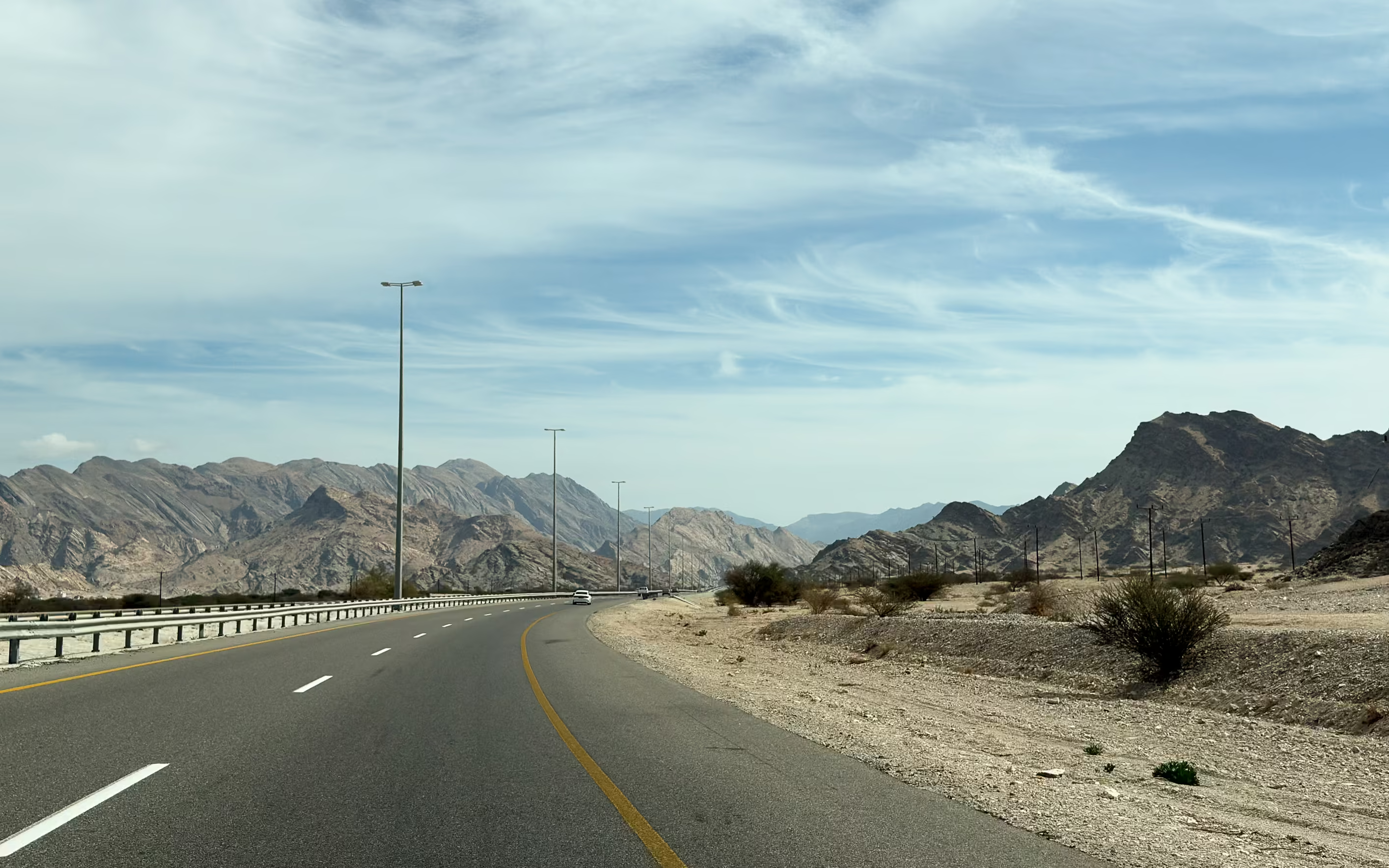
Driving in Oman is very similar to driving in Europe. Anyone who regularly drives at home will have no trouble getting around the Sultanate.
Driving is relaxed, clearly regulated, and often much less hectic than in many European cities.
Wide roads, good infrastructure, and breathtaking landscapes make every journey enjoyable.
In this post, we share our personal experiences of driving in Oman and provide helpful tips on car rental, road conditions, refuelling, traffic rules, and everything else you need to know for a safe and stress free road trip.
WHICH DRIVING LICENCE IS REQUIRED IN OMAN?
In most cases, your national driving licence is sufficient for driving in Oman.
However, some car rental companies may also require an international driving licence as an additional form of security.
It can also be useful to have one in case of police checks or if you are involved in an accident.
Therefore, our recommendation is to bring an international driving licence with you.
It usually comes with a small fee but can be very helpful if any issues arise.
Important: when applying, keep in mind that processing times may vary, so make sure to arrange it well before your trip.
DO I NEED A 4×4 VEHICLE IN OMAN?
This is probably the most frequently asked question when deciding on a rental car in Oman.
Our clear answer is yes, if you want to experience the country in all its diversity.
Yes, a 4×4 rental car is significantly more expensive than a standard vehicle.
However, if you plan to visit wadis, the desert, or mountainous regions during your trip, a four wheel drive vehicle is essential.
In some cases, it is even mandatory, as certain roads and areas may only be accessed with a 4×4, including Jebel Akhdar, Wadi Tiwi, and the Wahiba Sands desert.
If you are only planning a trip along the coast around Muscat, towards Sur, or an excursion to Nizwa and Jebel Shams, and mainly stay in larger towns, a standard car can be sufficient.
You will still have the option to visit wadis or the desert, but only by booking guided tours with transfers.

WHERE CAN I RENT A CAR FOR OMAN?
It is best to book your rental car before your trip for Oman. This ensures that you get a vehicle that suits your needs and gives you enough time to compare prices at your own pace.
We booked our rental car through DiscoverCars and had a very positive experience.
The value for money was excellent, which is why we can genuinely recommend DiscoverCars.
At the airport, we were welcomed directly, received a short introduction to the vehicle and to driving a four wheel drive, and were ready to start our road trip through Oman.
Of course, you also have the option to rent a car locally at the airport or in the city. However, this often involves more time and usually comes with higher prices.

WHAT SHOULD I CONSIDER WHEN BOOKING A RENTAL CAR?
To make sure your road trip is stress free and free from unexpected costs, there are a few important points to consider when booking a rental car.
Here is an overview of the most important factors:
- Unlimited mileageMake sure that your rental car includes unlimited mileage. Some providers only allow around 300 kilometres per day and charge extra for each additional kilometre.
Depending on your route and the length of your trip, this can add up quickly due to the long distances in Oman. - Insurance
We always book our rental cars with full insurance coverage, including collision damage and theft protection with no excess, as well as glass, tyre, and underbody cover, and third party liability insurance with a high coverage limit.
Good to know: always read the fine print carefully before booking. In many rental agreements, driving on unpaved roads is not permitted, even with a 4×4, or insurance coverage may not apply in such cases. In the event of damage, this can become very expensive. - Deposit
When picking up your car, you may be asked to leave a deposit with the rental company, usually by credit card.
The name of the cardholder must match the name of the main driver stated in the booking.
Depending on the provider and insurance package, deposits in Oman are often fixed and can be relatively low, and in some cases no deposit is required at all.
TRAFFIC RULES IN OMAN
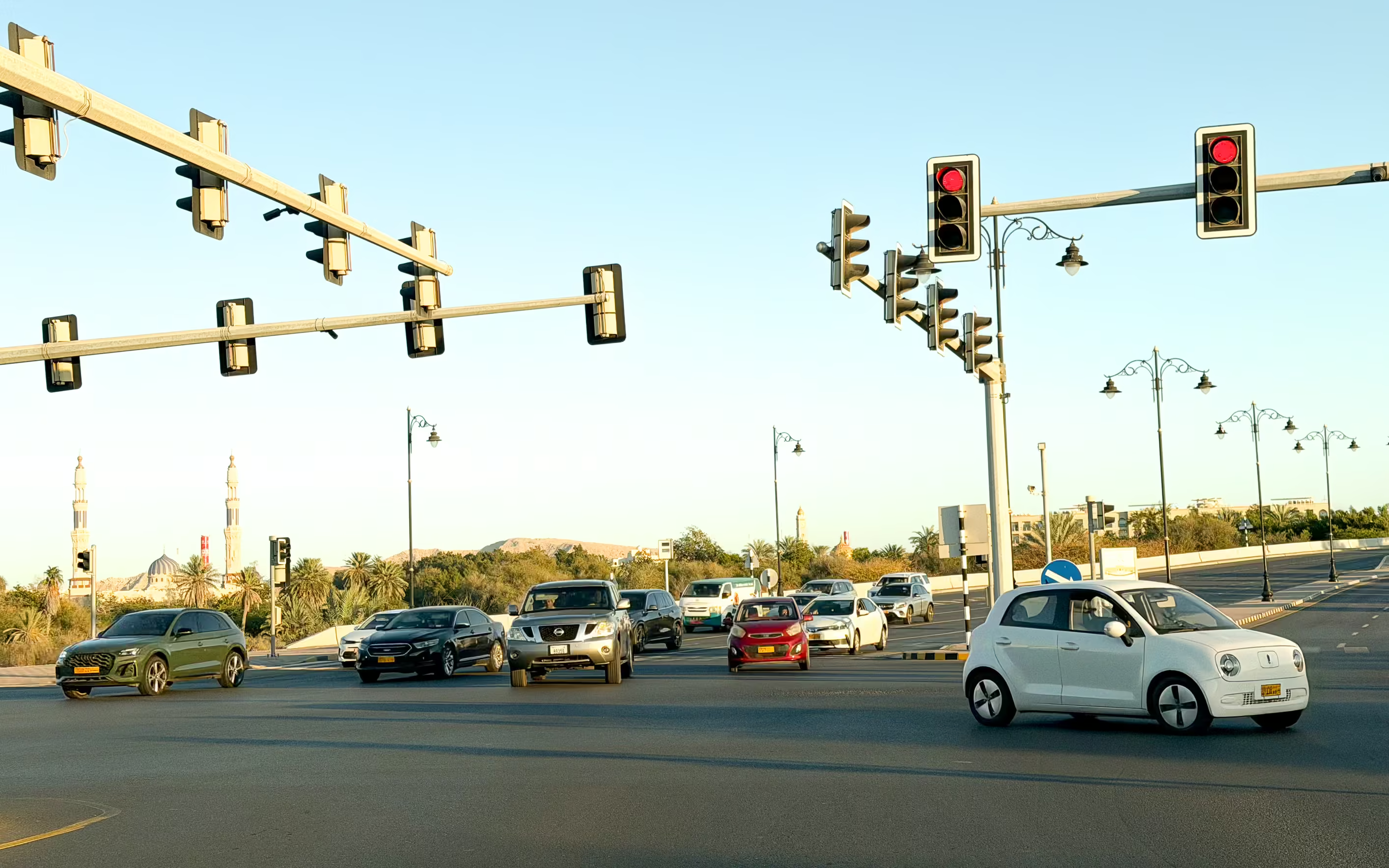
Traffic rules in Oman are generally comparable to those in many other countries. However, there are a few important things you should be aware of before driving.
Here are the quick facts:
- You drive on the right side of the road.
- There is no universal right of way rule. Priority is usually indicated by road signs or roundabouts.
- Roundabouts are very common. Vehicles already in the roundabout always have priority.
- General speed limits vary by road and are clearly signposted. In urban areas they are usually 40 to 60 km/h, outside urban areas 80 to 100 km/h, and on highways 100 to 120 km/h.
- Seat belts are mandatory for all passengers. This rule is strictly enforced and violations are fined.
- Children must be seated in an appropriate child seat for their age and must also be properly restrained.
- Alcohol consumption and mobile phone use while driving are strictly prohibited and punished with heavy fines.
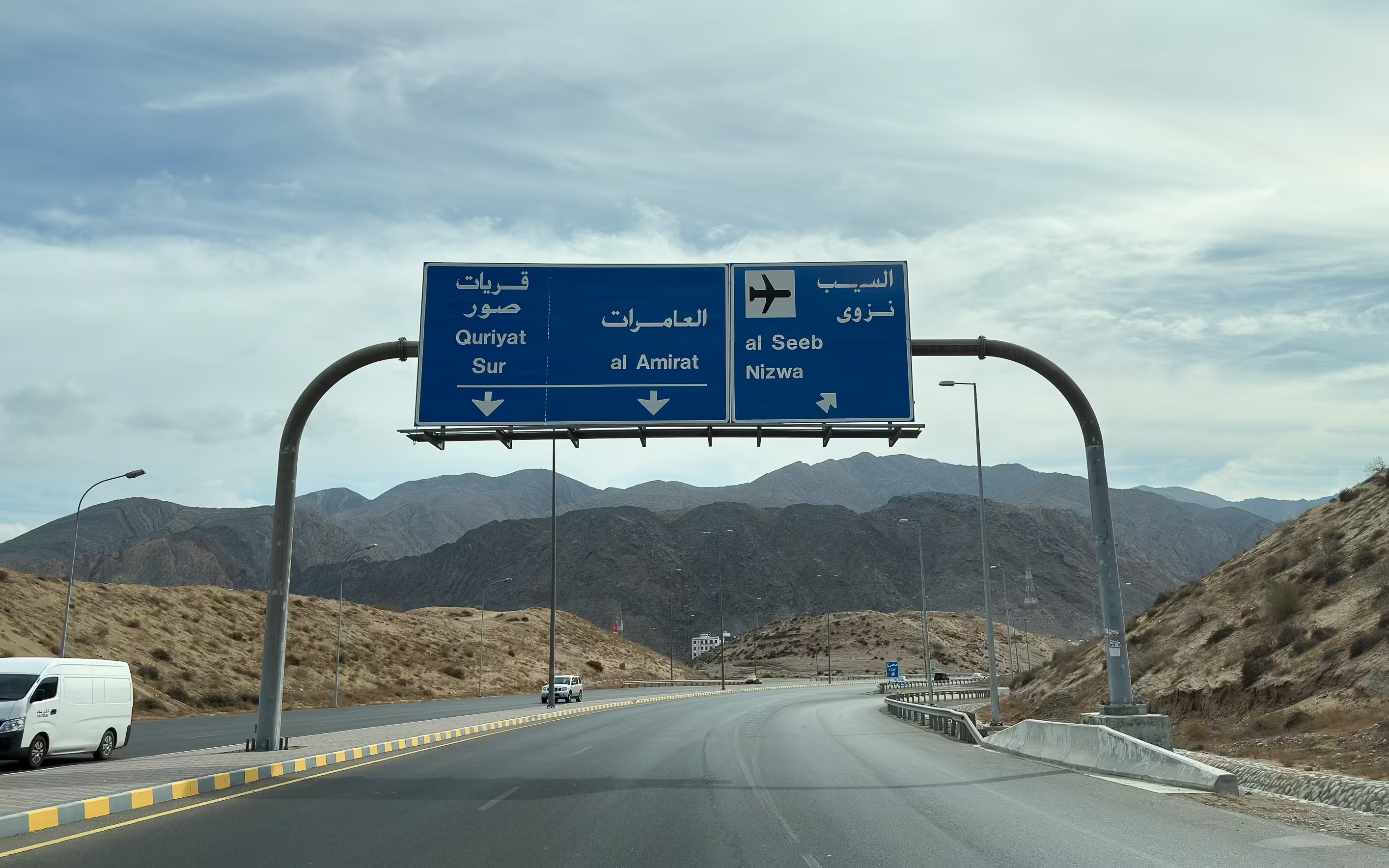
- Road signs are usually bilingual in Arabic and English and are easy to understand.
ROAD CONDITIONS IN OMAN
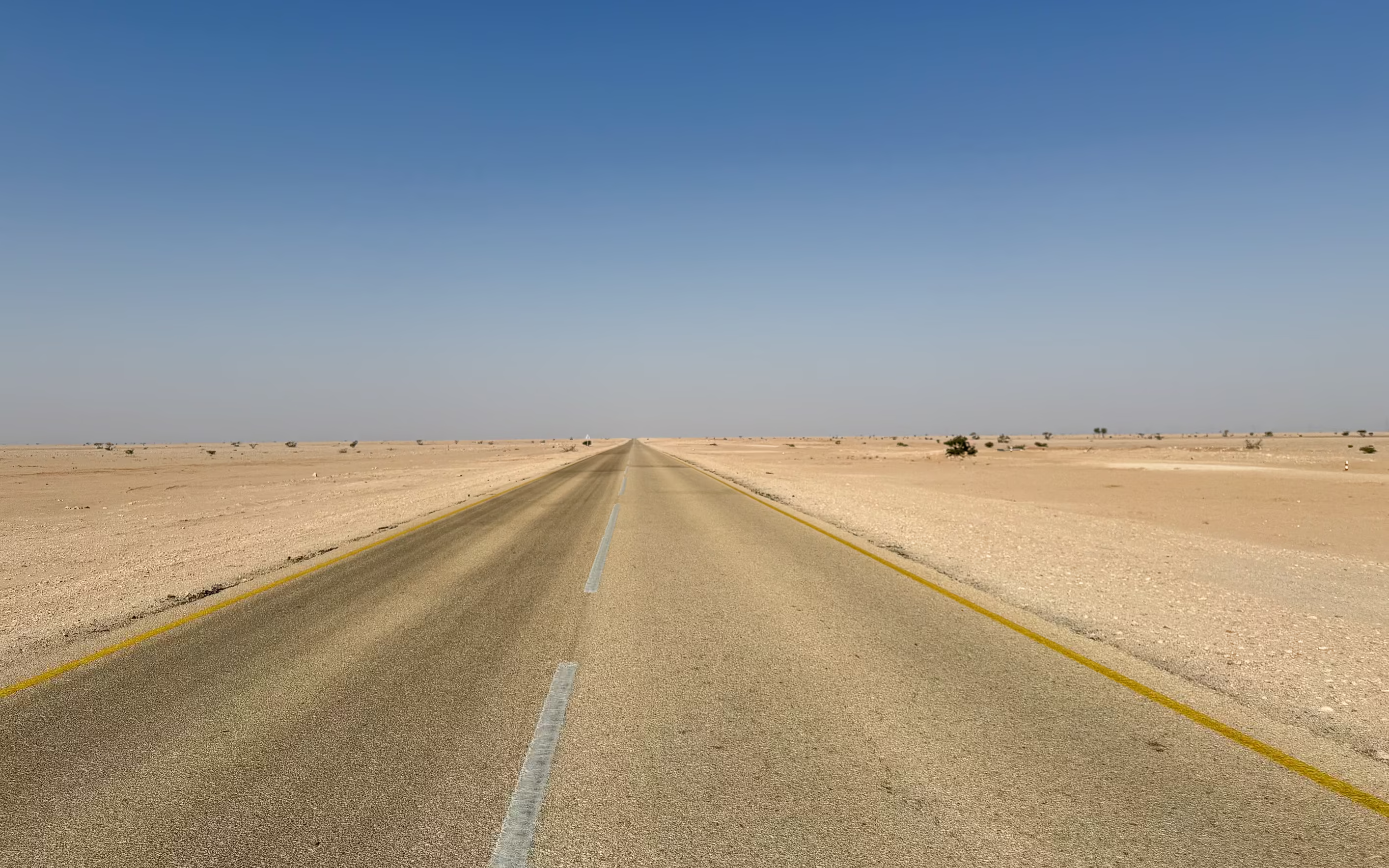
Road conditions in Oman are generally very good. This section refers only to paved roads, not off road tracks.
The Sultanate has invested heavily in its infrastructure for many years, and this is clearly noticeable.
Especially in urban areas and on highways, you will find wide, well maintained roads that are clearly signposted. There are also plenty of rest areas and parking options.
On rural roads, the road surface can occasionally be in poorer condition, and potholes are not uncommon.
However, there are still a few things to keep in mind when driving:
- Speed bumpsOften referred to locally as speed breakers, these are used to reduce traffic speed and are very common in Oman. You will frequently encounter them near exits, in residential areas, and around schools.
- Avoid driving at night
Especially in the southern parts of the country, roads can be extremely dark at night.
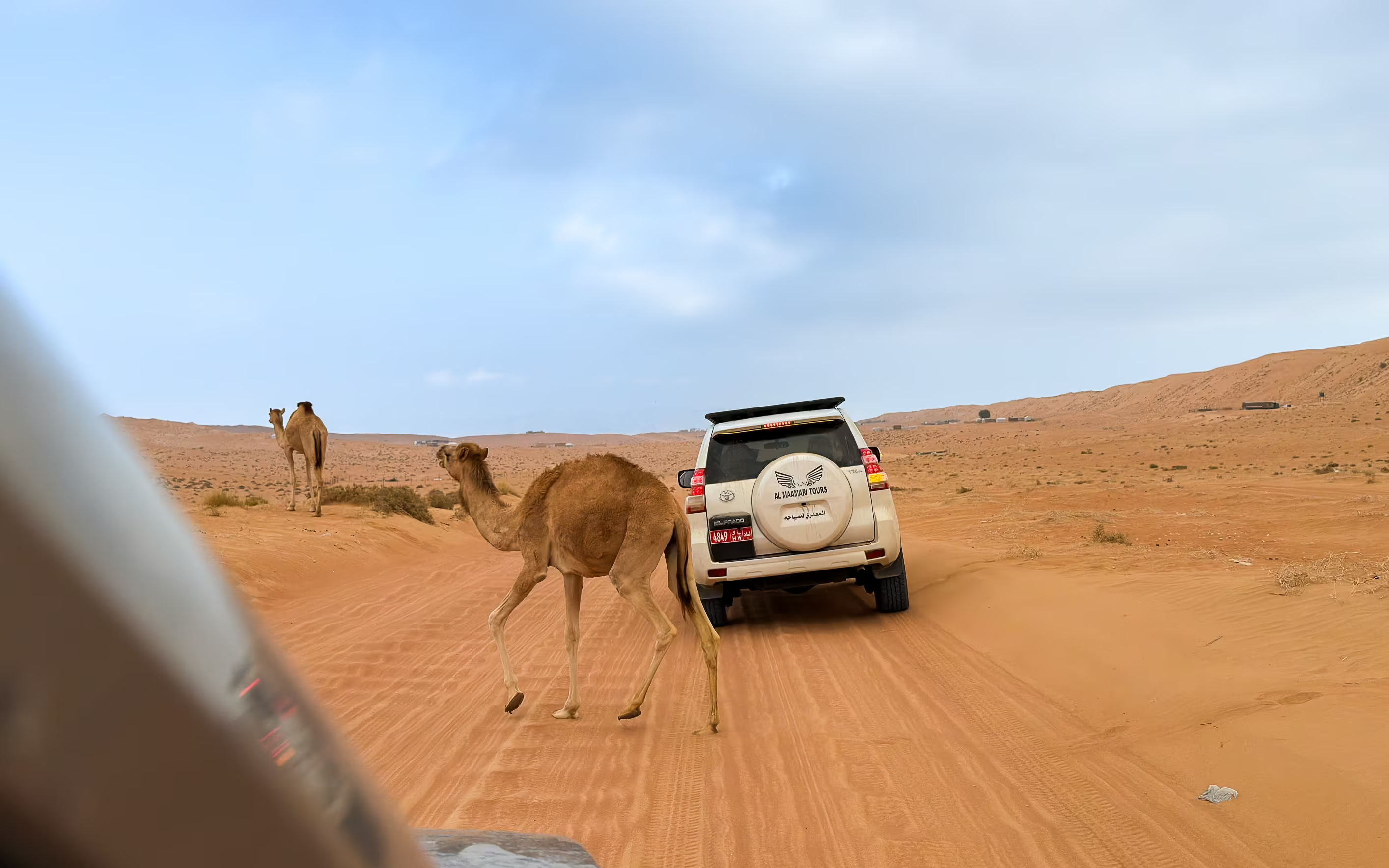
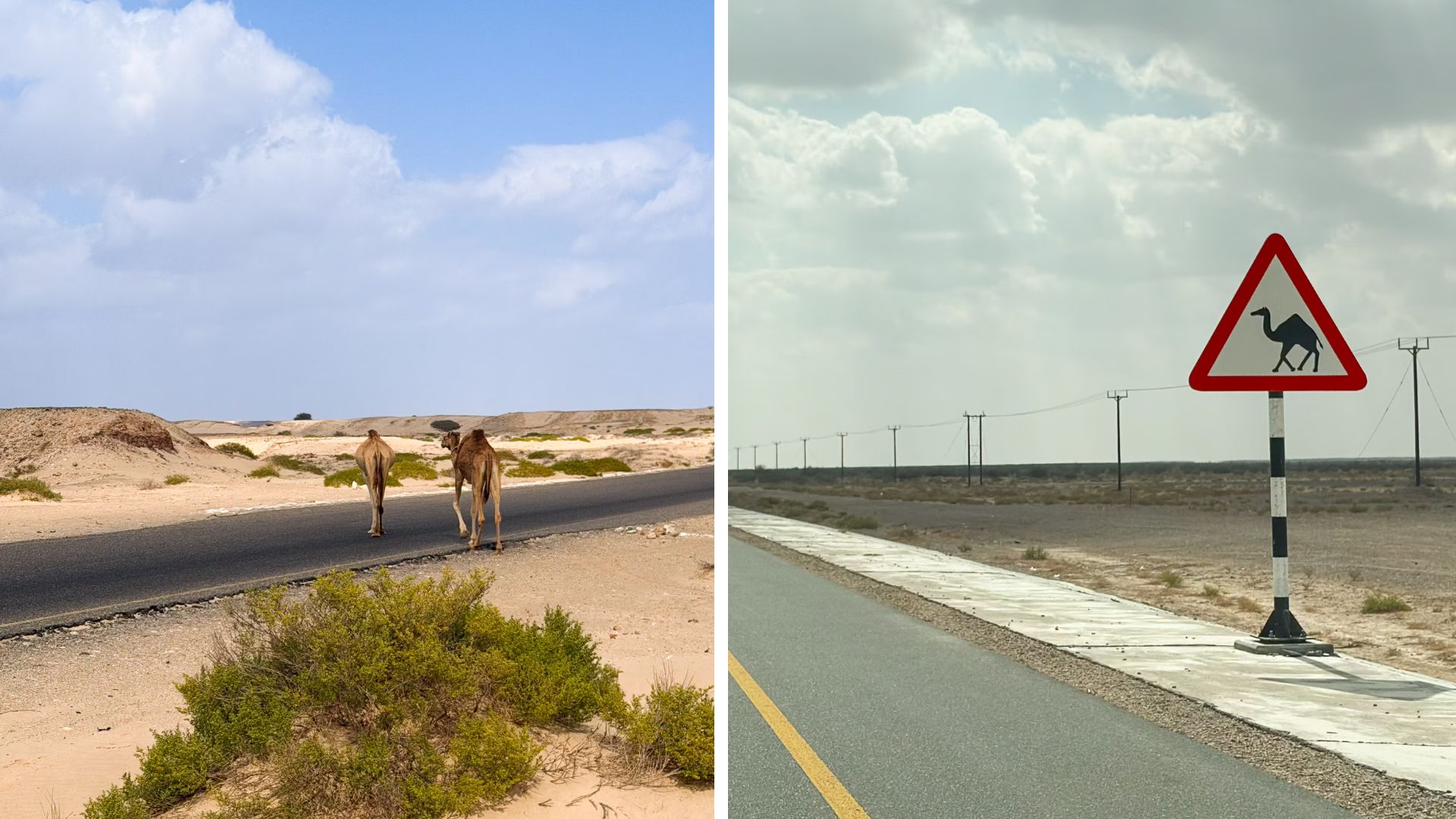
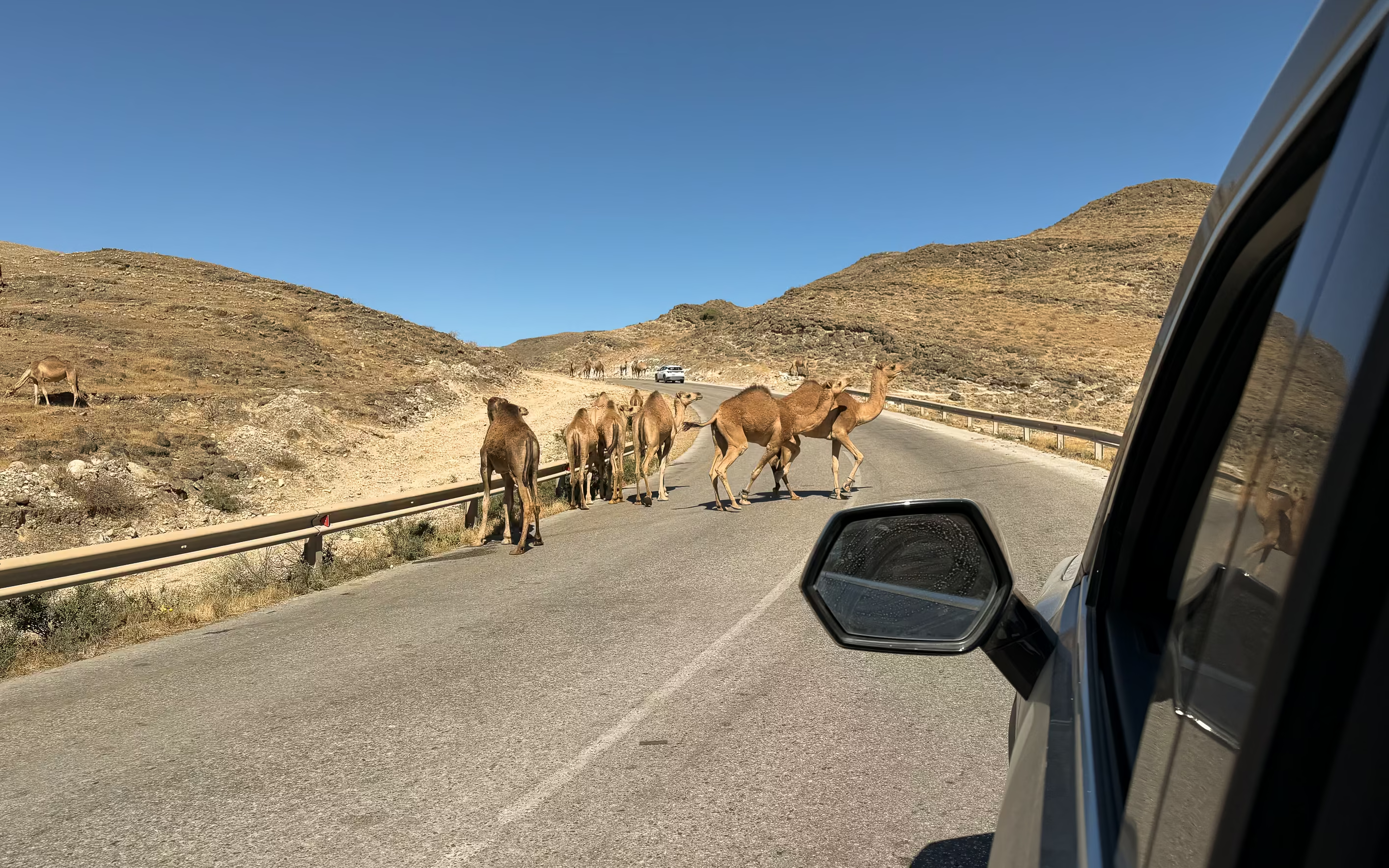
In addition, camels may cross the road unexpectedly, which can be very dangerous. Plan your routes so that you reach your destination during daylight hours whenever possible. - Watch out for camels and goats
These animals often wander onto the road without warning, particularly on rural roads and in remote areas.
OFF ROAD DRIVING IN OMAN: DESERT, MOUNTAINS AND BEACHES WHAT YOU SHOULD KNOW
Oman is a true paradise for anyone who enjoys travelling beyond paved roads.
However, this off road adventure is only possible if you are driving a 4x4 vehicle.
Without four wheel drive, you should never leave paved roads, as the risks in the desert, mountains, and on beaches are very high.
To make sure you stay safe off road and turn your trips into an unforgettable experience, there are a few important things you should always keep in mind:
WHAT YOU SHOULD ALWAYS CARRY WITH YOU:
- Enough water and snacks
- Offline maps
- A full tank and ideally an extra fuel canister
- First aid kit
- Tow rope and shovel
- Spare tyre
- Torch
- Power bank for your phone
- Sunglasses and sun protection
- Only drive if your vehicle is in perfect technical condition.
OFF ROAD DRIVING IN THE DESERT
- Reduce tyre pressure to around 60 to 70 percent, approximately 1 bar. This gives you much better grip on sandy surfaces.
- Do not drive alone. Especially in deep sand, a second vehicle can be extremely helpful. If you feel unsure, it is better to join a guided tour.
- Only drive during daylight hours.
- Respect marked tracks and routes. Do not drive randomly through the desert, as this is dangerous and harmful to the natural environment.

OFF ROAD DRIVING IN THE MOUNTAINS
- Rockfall and loose gravel are common, so drive slowly and anticipate changing conditions.
- Keep an eye on the weather. Rain can make tracks extremely muddy and slippery or even completely impassable.
- Checkpoint controls are strict. Access to Jebel Akhdar is only permitted with a 4x4 vehicle, and this requirement is carefully checked.
OFF ROAD DRIVING ON OMAN’S BEACHES
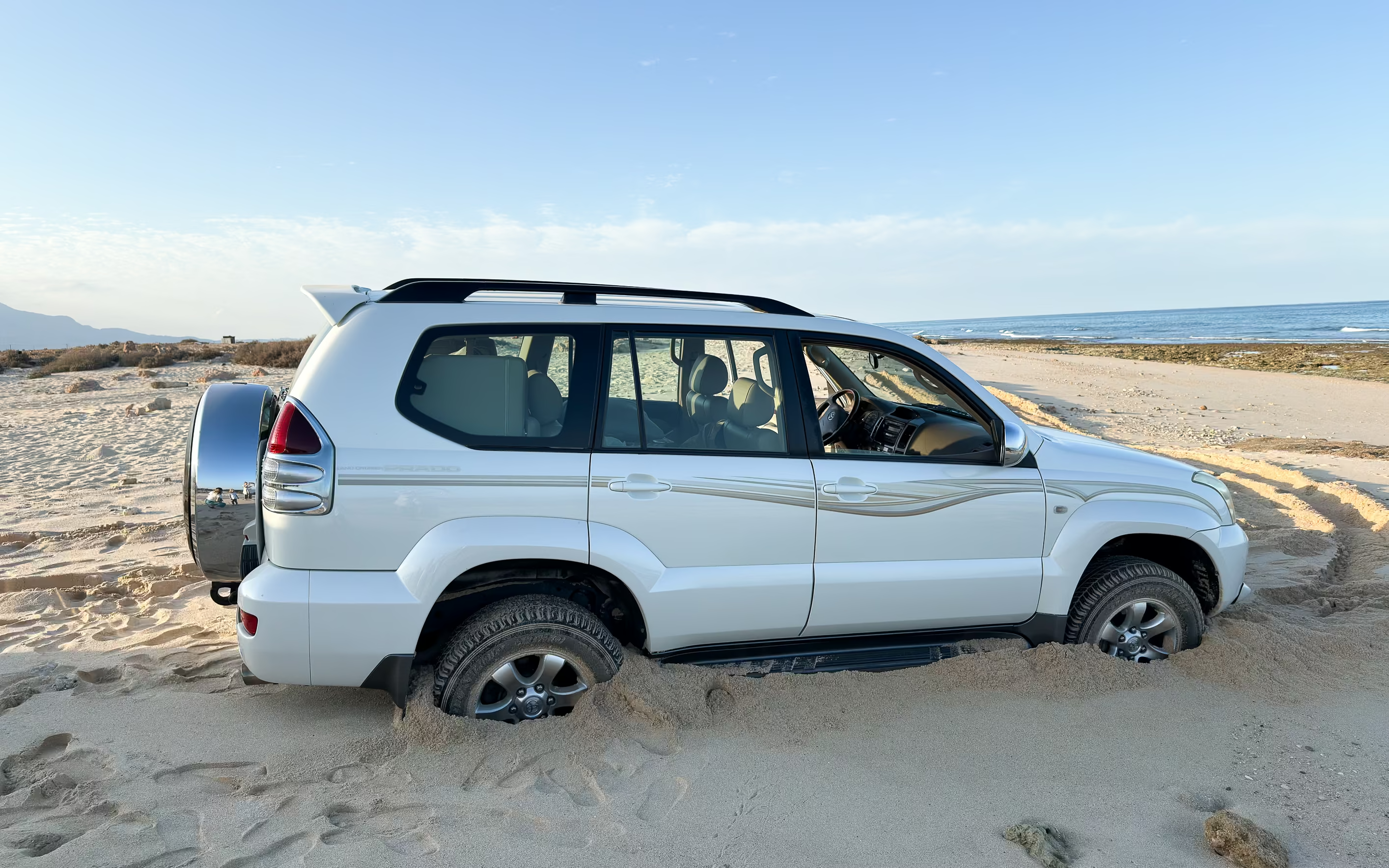
- Always check in advance whether driving is allowed. Some beaches are wide and firm enough, while others are too narrow or have very soft sand.
- Only drive on hard, compact sand. Soft sand can easily cause your vehicle to get stuck.
- Do not drive too close to the water. Tides often come in faster than expected.
OFF ROAD DRIVING THROUGH WADIS
- Never drive through a wadi during rain or when thunderstorms are forecast. Flash floods can flood dry riverbeds within seconds.
Rainfall in the mountains collects and then rushes through the wadi into the valley at high speed. The resulting masses of water and landslides repeatedly lead to serious and sometimes fatal accidents. - Always check water levels in advance. Use the water level markers along the route and test puddles or water crossings with a stick to assess their true depth.
Just a few extra centimetres can be enough to get a vehicle stuck. - If you feel unsure at any point, always turn around.
NAVIGATION IN OMAN
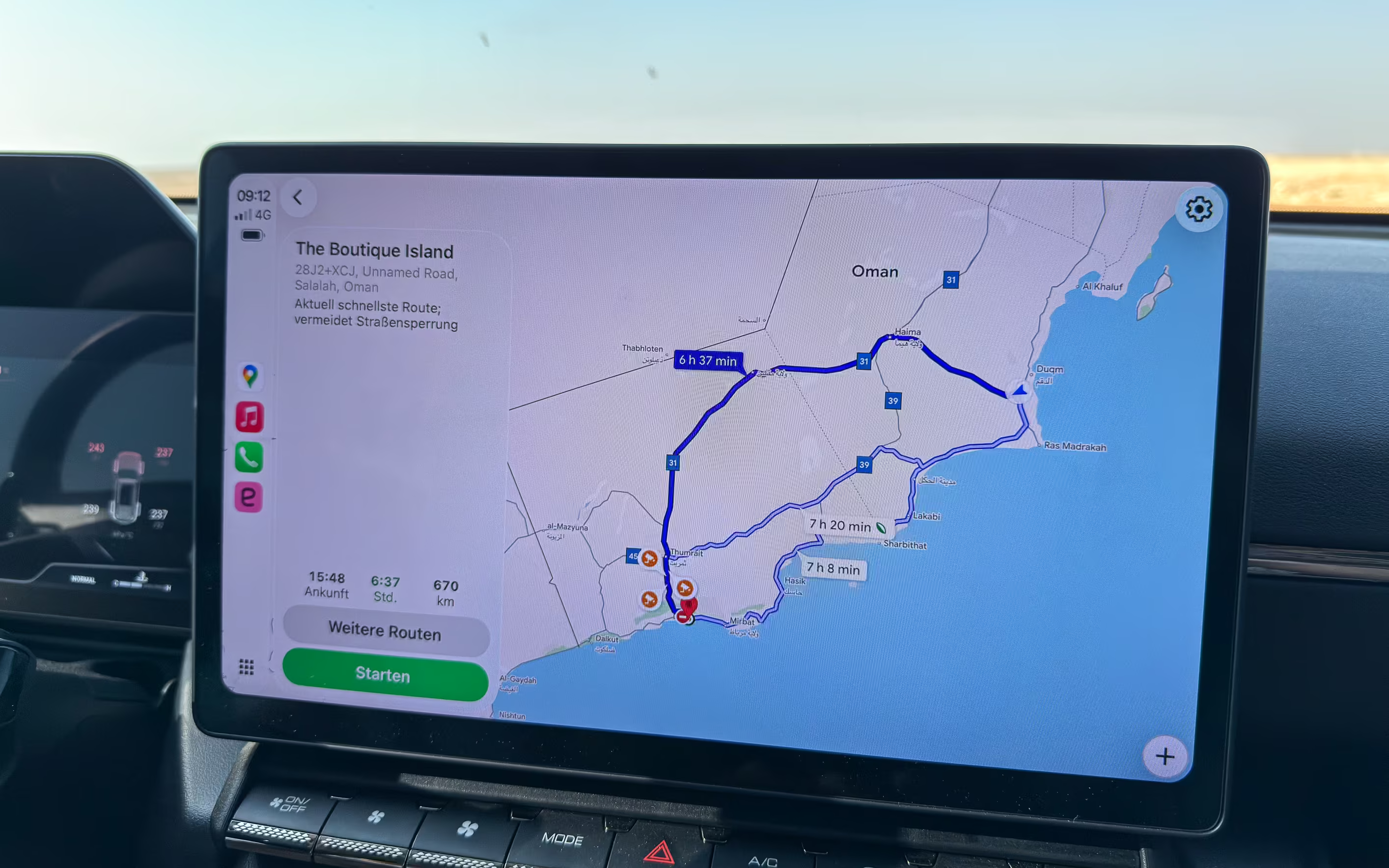
It is best to download offline maps from Google Maps or Maps.me before your trip. These navigation apps usually work very well, especially in cities such as Muscat, Nizwa, or Salalah.
We also bought a local SIM card on arrival to use mobile internet, which made navigation even easier.
Off road navigation can be more challenging. Many off road routes and smaller tracks are not always shown correctly, or the actual road conditions are much worse than the app suggests.
For this reason, you should not rely solely on your navigation system when driving off road.
If a route feels unsafe or too challenging, it is always better to turn around and choose an alternative option. Safety should always come first, especially in remote areas.
REFUELLING IN OMAN
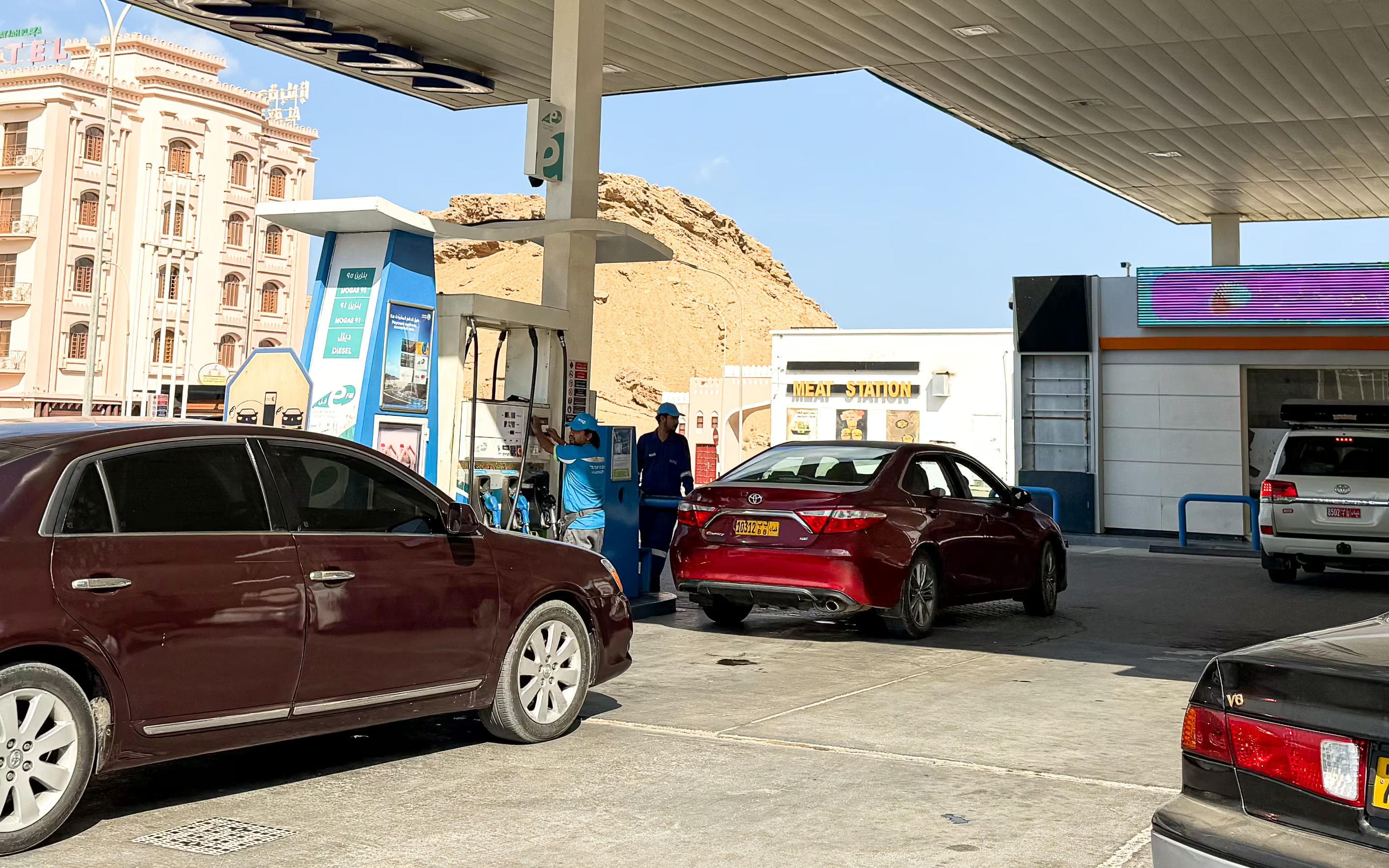
Refuelling in Oman is not only very convenient but also extremely affordable. At most petrol stations, an attendant will refuel your car for you.
You simply stay seated in the vehicle and tell the staff member how many Omani rials you would like to spend or whether you want a full tank.
Based on the fuel cap, the attendant knows exactly which type of fuel to use.
Payment is possible in cash as well as by credit card. In remote areas, however, it is advisable to carry some cash with you in case card payment is not available.
A small tip for the attendant is not required but is generally appreciated.
Good to know: in very remote areas such as the desert, mountainous regions, or sparsely populated parts of the country, you should always refuel in advance.
Petrol stations can be few and far between or may not be available at all.
PARKING IN OMAN
Compared to many other countries, parking in Oman is relatively straightforward. However, there are still a few important things to keep in mind to avoid problems and unnecessary costs.
In many urban areas, you will find free parking spaces, especially in front of supermarkets, restaurants, at beaches, and near popular attractions. Many hotels also offer free parking directly on site.
In busier districts such as Muttrah, Ruwi, or around the Corniche in Muscat, there are paid parking zones. These areas are clearly signposted and explained in both English and Arabic.
Payment is usually made at a parking machine or via a mobile app.
Good to know: even if you have a valid parking ticket, you should never
- park on pavements
- park in the second row
- block driveways
- park too close to roundabouts or intersections
- park in yellow marked areas
Depending on the violation, fines can quickly amount to 20 to 50 Omani rials, roughly 50 to 130 dollars.
If you are recorded for illegal parking or a missing ticket, the offence is registered electronically and forwarded directly to your rental car provider.
The fine will then be charged to you by the rental company, sometimes even weeks after your trip.
SPEED CAMERAS IN OMAN
If you want to avoid unnecessary expenses during your trip, it is essential to stick to the posted speed limits in Oman.
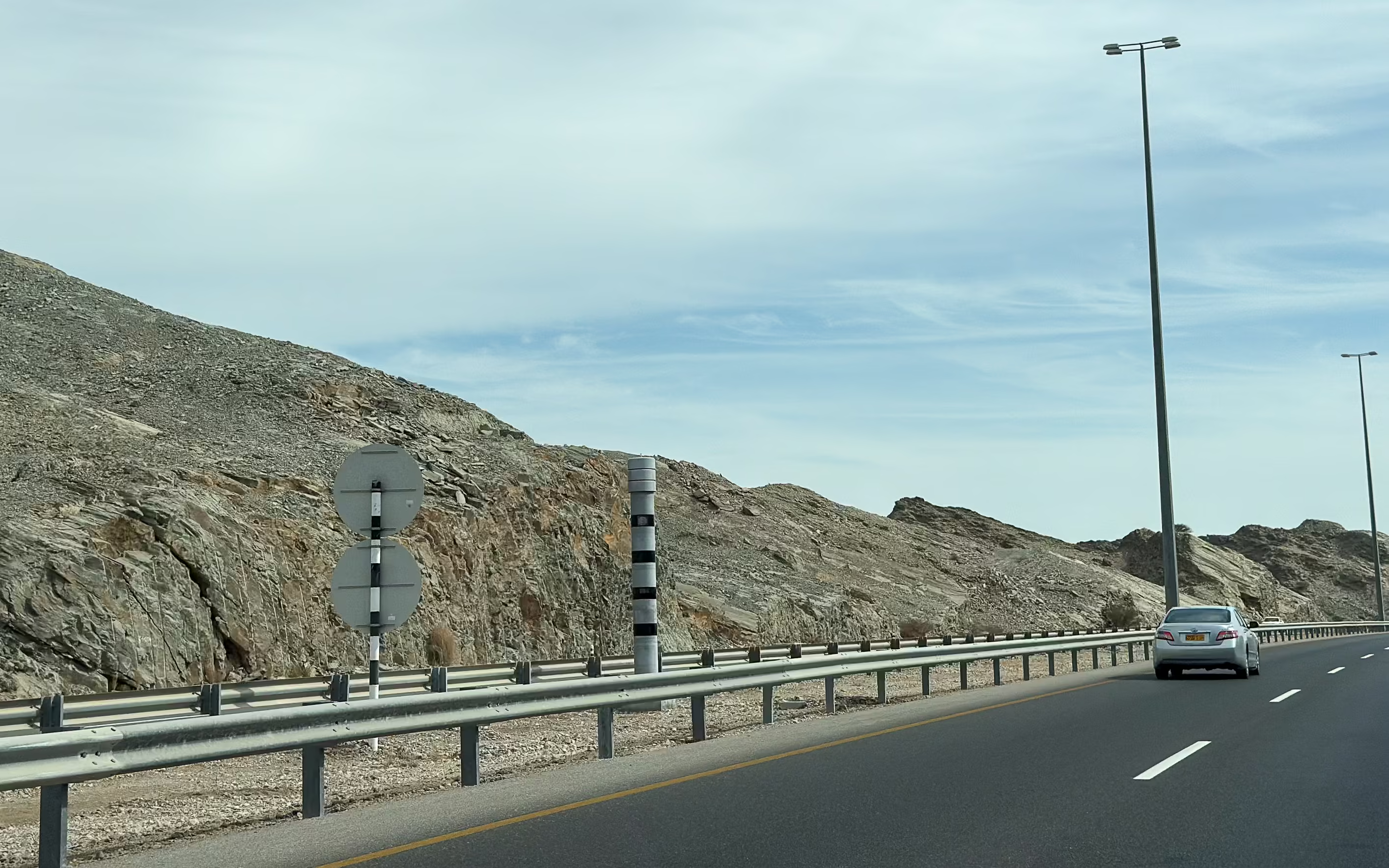
There are numerous fixed speed cameras as well as mobile radar controls throughout the country, and fines can be expensive.
Some cameras are clearly visible, while others are well hidden, for example in unmarked SUVs parked along the roadside.
You will find a particularly high number of speed cameras on highways in the north of the country, especially around Muscat, Nizwa, Sohar, and Salalah.
Fines can be quite substantial. Speeding offences are recorded digitally. If you are caught by a speed camera, your rental car provider is automatically notified and will charge the fine to your credit card, often including an additional administration fee. It is also possible that the charge only appears weeks after you have returned home.
For this reason, it is strongly recommended to always respect the speed limits in Oman.
Using a mobile phone while driving is punished even more severely. It is best to leave your phone with the passenger and focus fully on the road.
This will save you stress and a significant amount of money.
WAS THIS POST NOT ENOUGH FOR YOU? ARE YOU LOOKING FOR MORE TIPS, INSPIRATION, AND PLACES TO SEE FOR YOUR OMAN TRIP? THEN MAKE SURE TO CHECK OUT OUR FOLLOWING POSTS:
- Discover Muscat: Sights & Tips for Oman’s Capital
- Oman with a Baby or Toddler: Tips, Useful Information & Our Experience
- Oman Road Trip Itinerary for Self Drivers
- Road Trip Through Northern Oman: Highlights Between Muscat, Coast, Wadis, Desert, and Mountains
USEFUL LINKS & RECOMMENDED TRAVEL GUIDES FOR YOU
- Discover the best accommodations
- Find affordable flights at skyscanner.com
- Find affordable rental cars at DiscoverCars
- The best Travel Guides for Oman
- Unique Excursions to Experience in Oman
Note: This blog post contains our personal recommendations in the form of so-called affiliate links. If you book or purchase something through these links, we earn a small commission. There is absolutely no change to the price for you.
Table of contents
Our Travel Destinations


Newsletter
Subscribe to our newsletter
Vielen Dank! Sie haben sich erfolgreich für unsere Updates angemeldet!
Oops! Etwas ist beim Absenden des Formulars schief gelaufen.
If you have any questions or additions to this blog post, feel free to send us a message.
Vielen Dank! Ihre Nachricht wurde erfolgreich gesendet, und wir werden Ihnen bald antworten!
Oops! Etwas ist beim Absenden des Formulars schief gelaufen.